
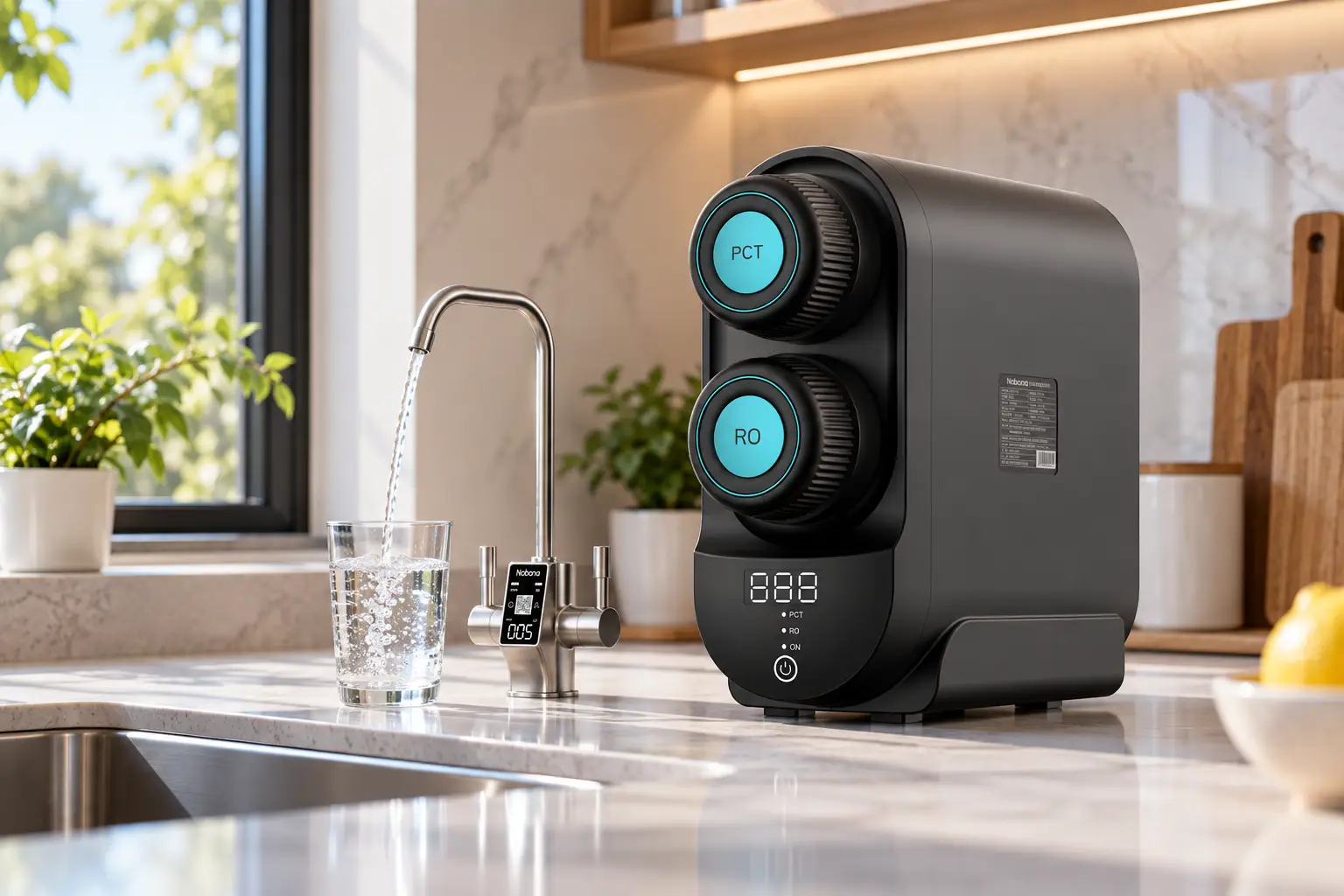
Water may look clear when it comes from the tap, but appearance alone doesn’t tell you everything about its quality. Depending on your water source and local conditions, dissolved minerals, salts, chlorine-related compounds, and other substances may still be present.
For homeowners looking for an additional level of filtration specifically for drinking and cooking water, reverse osmosis (RO) is one of the most widely recognized filtration technologies available.
But what exactly is reverse osmosis, and how is it different from whole-home filtration?
Reverse osmosis is a water filtration process that pushes water through a very fine membrane.
The membrane allows water molecules to pass through while helping separate many dissolved substances and other unwanted impurities from the water.
That’s why RO systems are commonly installed in or around the kitchen and used primarily for:
A modern reverse-osmosis system doesn’t usually rely on just one filter. Water moves through several filtration stages, with each stage performing a different job.
Before water reaches the RO membrane, preliminary filtration helps capture larger particles and sediment. This also helps protect the more advanced filtration components further inside the system.
Carbon filtration can help reduce chlorine, unpleasant tastes, odors, and certain other substances. This stage is particularly important because better-tasting water isn’t only about what gets filtered out – it is also about improving the overall drinking experience.
This is the heart of an RO system. The membrane contains extremely small pores designed to separate many dissolved substances from the water as it passes through. The result is highly filtered water intended primarily for drinking and cooking.
Depending on the system, additional filtration stages may further refine the water before it reaches your faucet. Modern RO systems can combine several filtration technologies into one compact appliance.
This is one of the most common questions homeowners have. The easiest way to understand the difference is where the filtration happens and what the filtered water is used for.
A whole-home filtration system treats water as it enters the property. That means filtration can benefit water used throughout the home – from showers and bathrooms to kitchens, laundry, and other fixtures.
A reverse-osmosis system generally focuses on producing highly filtered water at a specific point of use, particularly the kitchen.
Rather than thinking of one as a replacement for the other, the two systems can serve different purposes.
Whole-home filtration = water throughout the house.
Reverse osmosis = advanced filtration for drinking and cooking water.
For homeowners looking for a more complete approach to water filtration, the two technologies can complement each other.
Traditional RO systems often use a storage tank to hold filtered water.
Newer tankless RO systems take a different approach.
By filtering water as needed, a tankless design can provide several practical advantages, including a more compact installation and less equipment taking up valuable cabinet space.
Modern systems can also incorporate features such as:
These improvements are helping make reverse osmosis more convenient for everyday households.
That depends on your water, your household, and what you want your filtration system to accomplish.
If your main concern is improving the water you drink and cook with, an RO system may be worth considering.
If you’re looking to address water throughout the entire property – including showers, bathrooms, laundry, and kitchen fixtures – a whole-home filtration system may be more appropriate.
And for homeowners who want both, combining whole-home filtration with point-of-use RO filtration can provide a more comprehensive solution.
The best place to start is understanding what’s actually in your water.